Species and habitat
Students link their knowledge of plant species with the environment in which they grow and with their ecological requirements (moisture, light, soil, type of land management).
🌿 BOTANIKA – Green Nature v7 🌿
Modern educational application for Windows 10 and 11
This methodology is part of a broader approach to teaching botany. If you are looking for a general guide, we also recommend:
👉 How to Teach Plant Identification Effectively
Students are given a biotope – a meadow, a beech forest, a wetland or a peat bog – and their task is to find plants in the BOTANIKA – Green Nature database that they think grow there. They add the chosen species to their own list using the “Assign plants to biotope” button. But adding a plant is not enough: students must be able to explain why it belongs there. The activity links species ↔ habitat ↔ ecological conditions and teaches students to look up information, decide, assign and defend their choice.
Students link their knowledge of plant species with the environment in which they grow and with their ecological requirements (moisture, light, soil, type of land management).
Students independently search for and verify information in the app database, in a textbook or on the internet, and critically assess whether it is correct.
Students can defend their assignment of a plant in their own words and understand that one plant can grow in several biotopes.
The best option for a full lesson. For example, divide 24 students into 6 groups of four and give each group a different biotope. Each group’s task is to find about 8 species.
Instead of a biotope, the teacher gives a plant: “Look up meadow clary. Which of the 22 biotopes would you assign it to? Justify your decision.” This variant is more demanding.
The teacher deliberately assigns several doubtful or wrong plants to a chosen biotope (e.g. adds white water lily or round-leaved sundew to the meadow next to ox-eye daisy and red clover). Students answer: “Which of these plants would you remove from the biotope, and why?”
Connects the app with real observation of nature. Before the trip: “Explore the meadow biotope and choose 10 species that you expect we might find on our field trip.” Students assign them in BOTANIKA.
Do not give students a list of correct plants in advance. The independent search is the most valuable part of the activity from a teaching point of view – students have to browse the database, read the information on each plant’s habitat (the [Habitat] section of every plant description) and make their own decision. Textbooks or the internet can also help. The most valuable moments tend to be the debatable cases that spark discussion in class.
The teacher briefly explains what a biotope is and shows the list of 22 biotopes in the app. Each group is given one biotope. Not everyone has to work on the same one – on the contrary, the more biotopes, the more interesting the final comparison.
The groups read the description of their biotope and look at the photographs. They find out what conditions prevail there – moisture, light, soil, and whether people mow, graze or cultivate it. They will need this information later to justify their choices.
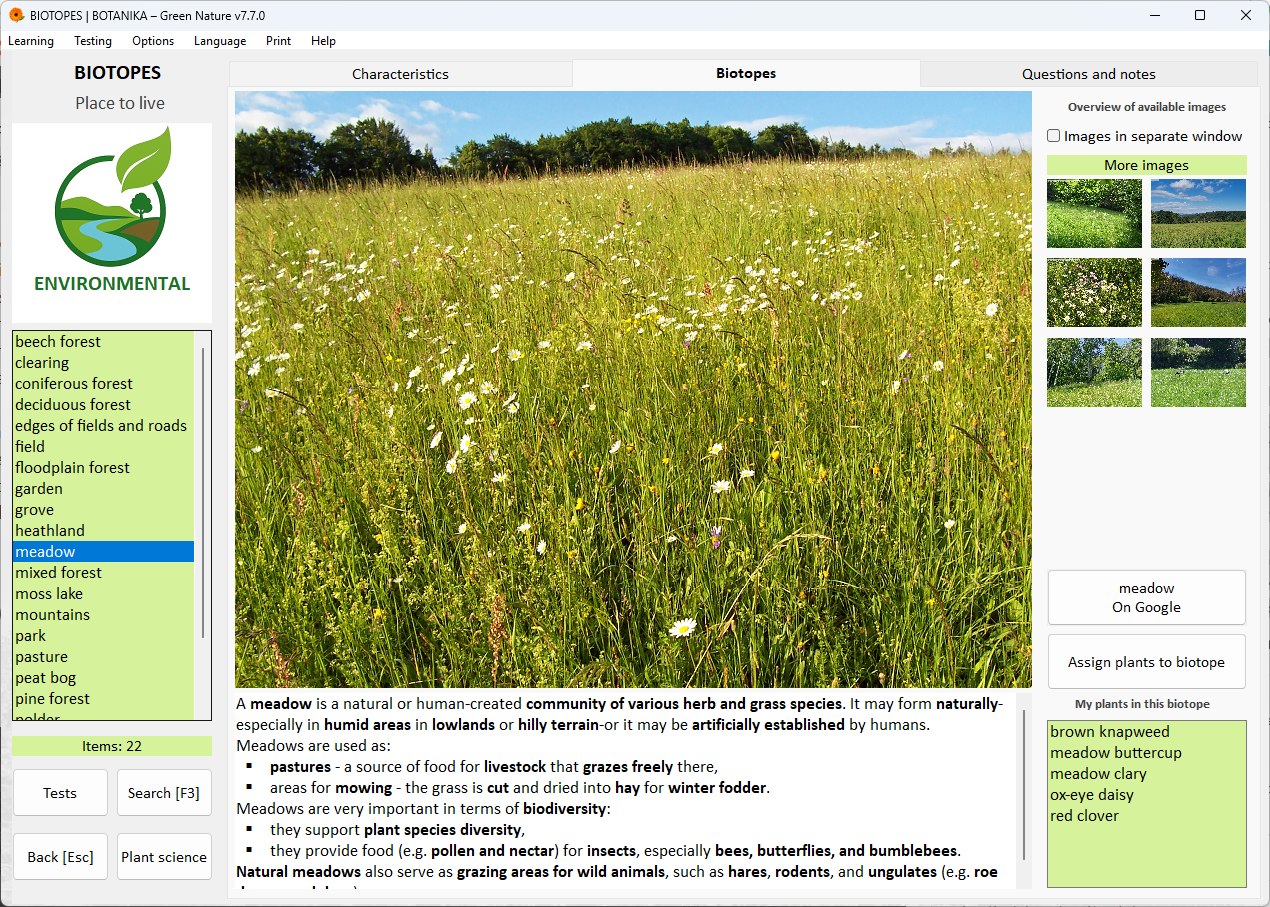
The main part of the lesson. The groups browse the plant database and consider for each plant whether it can grow in their biotope. The key is the [Habitat] section of each plant. They add the chosen species with the “Assign plants to biotope” button – the plants then appear in the “My plants in this biotope” list.
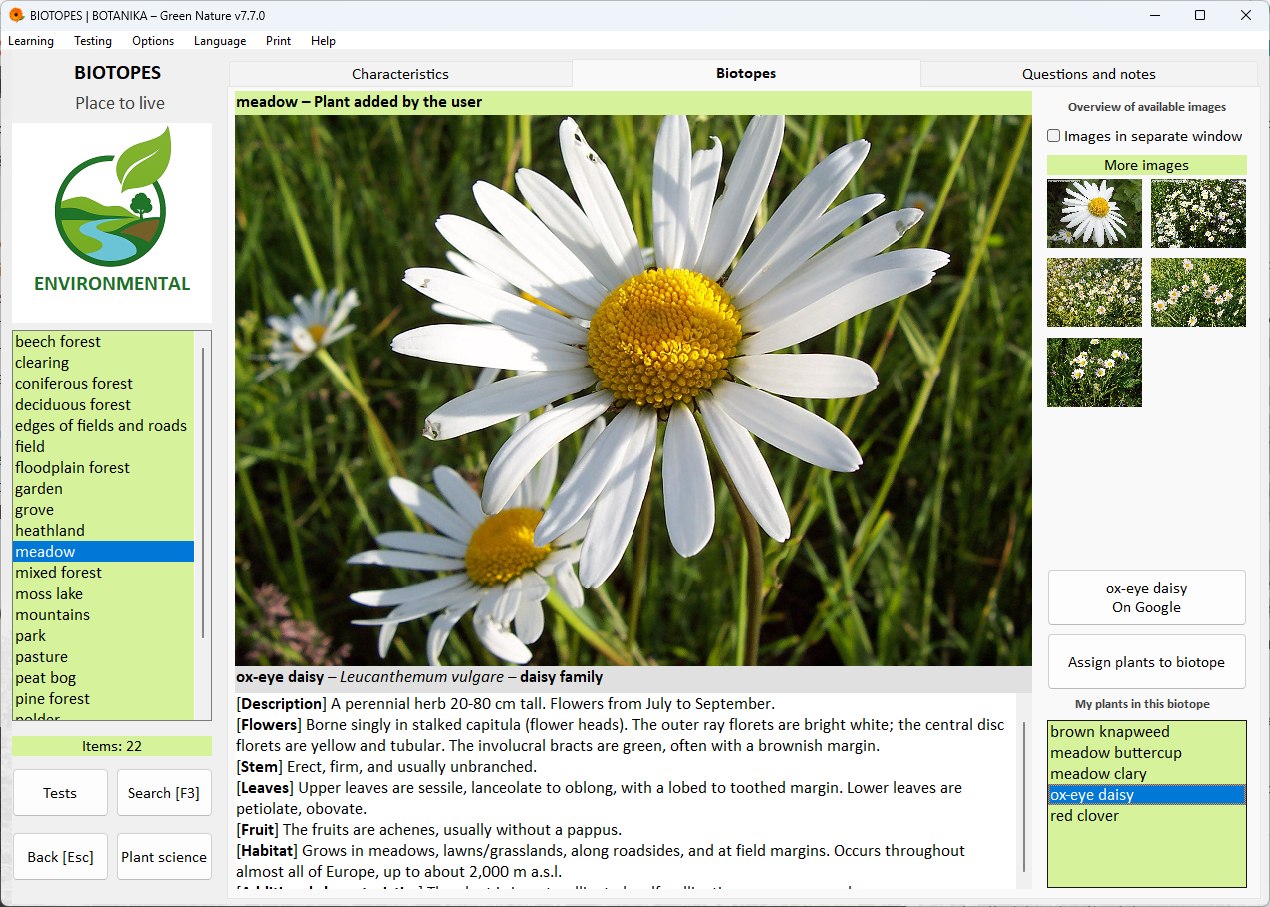
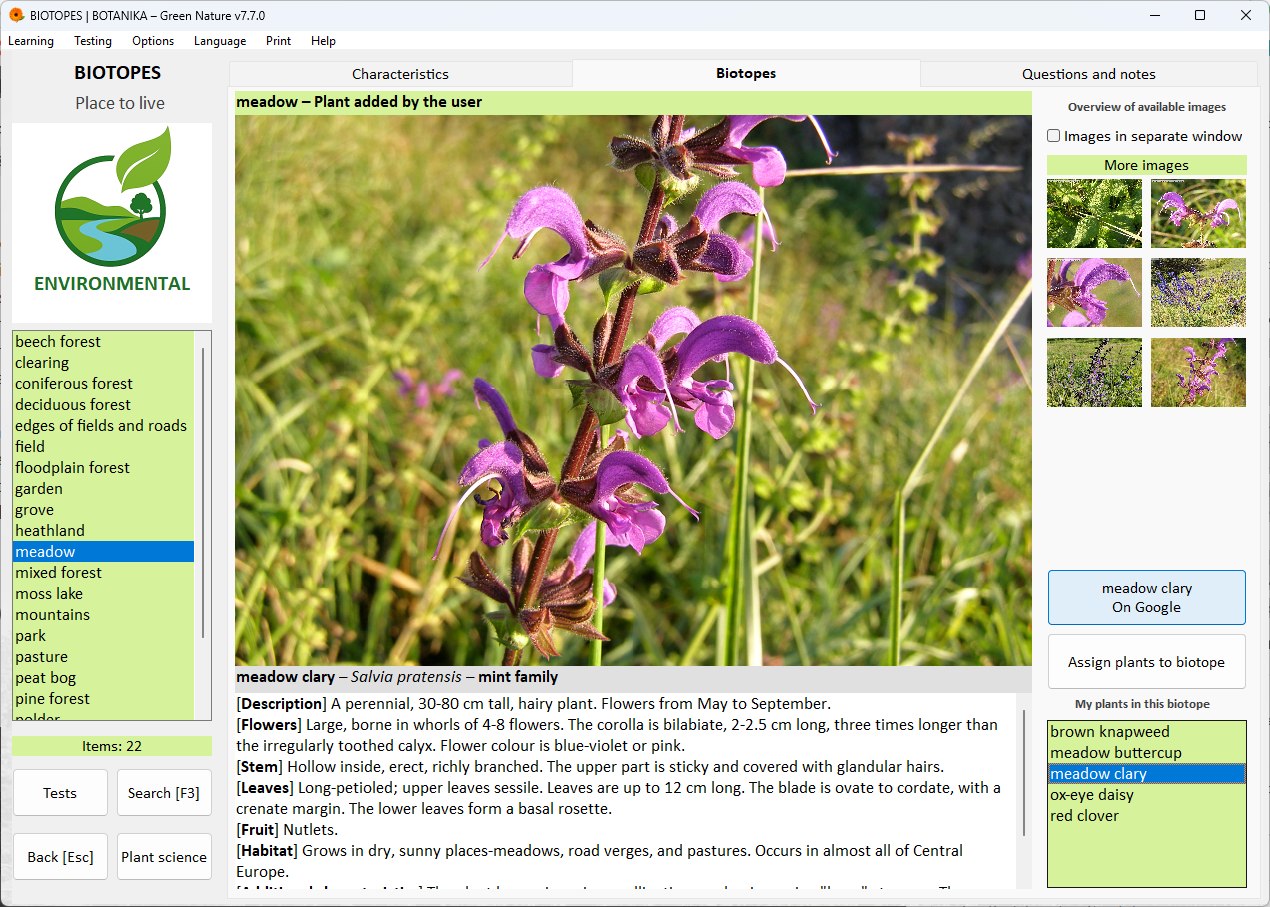
The teacher walks around the groups and picks individual plants from their lists. Students no longer just name a plant; they have to connect species ↔ habitat ↔ ecological conditions. Example for the meadow: ox-eye daisy, red clover, meadow clary, brown knapweed, meadow buttercup.
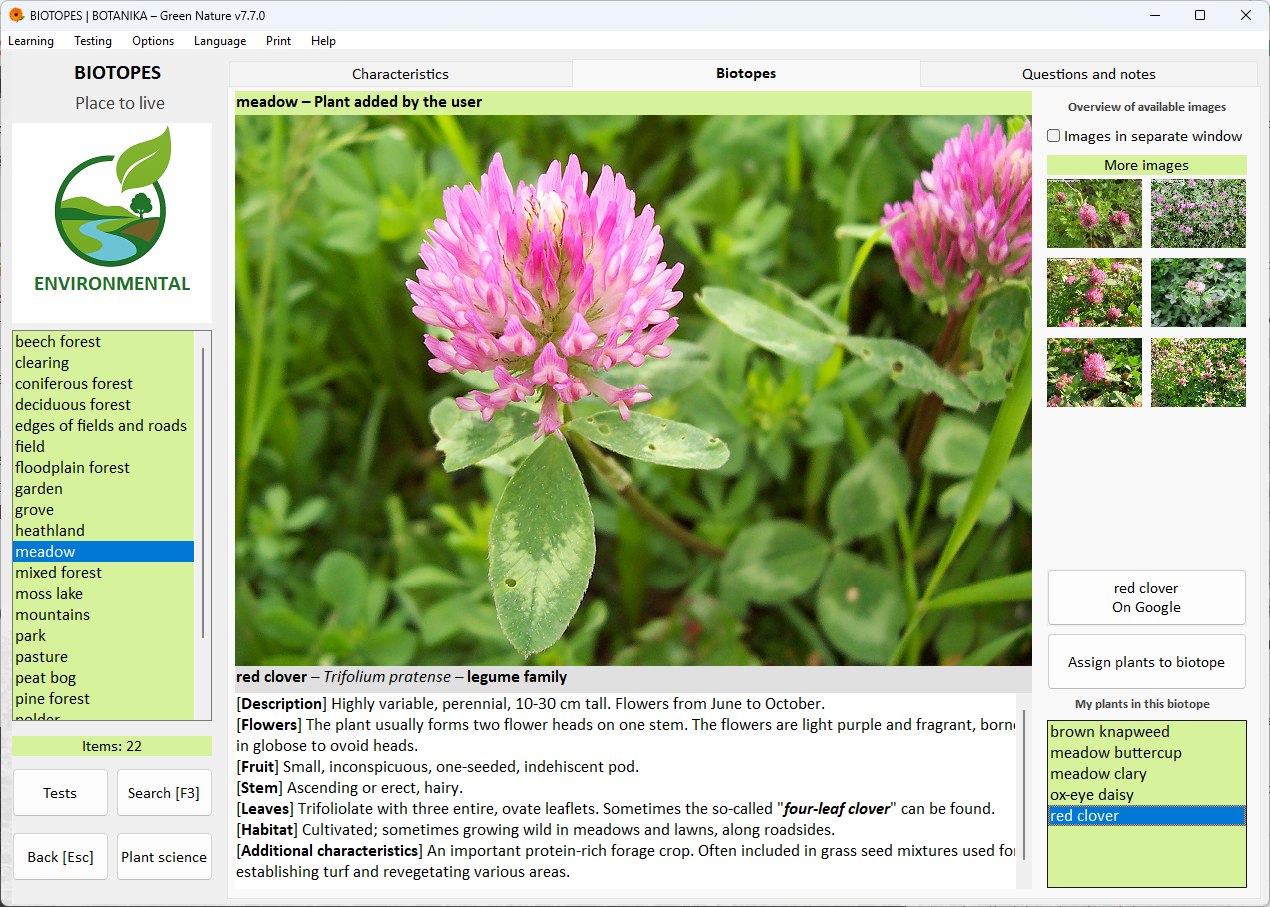
Each group projects its biotope and presents 2–3 plants: “We put this plant in the wetland because…” The others look for overlaps: did the same plant appear in several biotopes? This is the right moment to stress that a plant does not have to belong to just one biotope.
The teacher sums up the main point: where a plant grows is determined by the conditions of its environment – and one plant can be at home in several biotopes.
Aim of the activity: Students link their knowledge of plant species with their habitat and ecological requirements and can justify their assignment.
Find 5 plants typical of the given biotope.
Find 10 plants and justify the assignment of each one.
Choose plants that can be assigned to several biotopes and explain why.
BOTANIKA – Green Nature (teacher’s computer with a projector, or student devices), and a biology textbook or the internet for checking information if needed.
Students do not receive a ready-made list – they have to search, decide and defend their decisions.
Plant identification is linked to the environment, ecological requirements and the protection of biodiversity.
Three levels of difficulty and four activity variants – from a 20-minute warm-up to a project with a field trip.
BOTANIKA – Green Nature contains 22 biotopes with descriptions and photographs, and an extensive plant database including habitat information. The “Assign plants to biotope” function turns them into a ready-to-use inquiry activity with no complicated preparation.